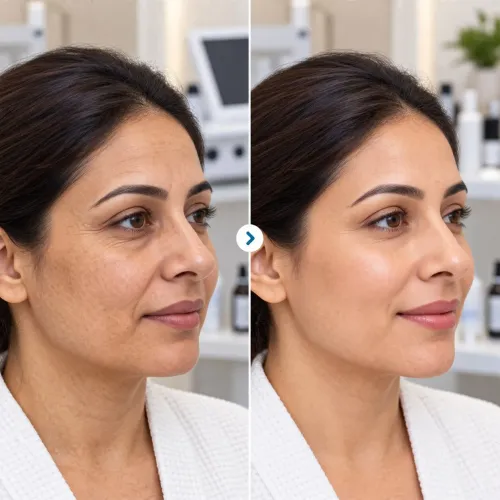
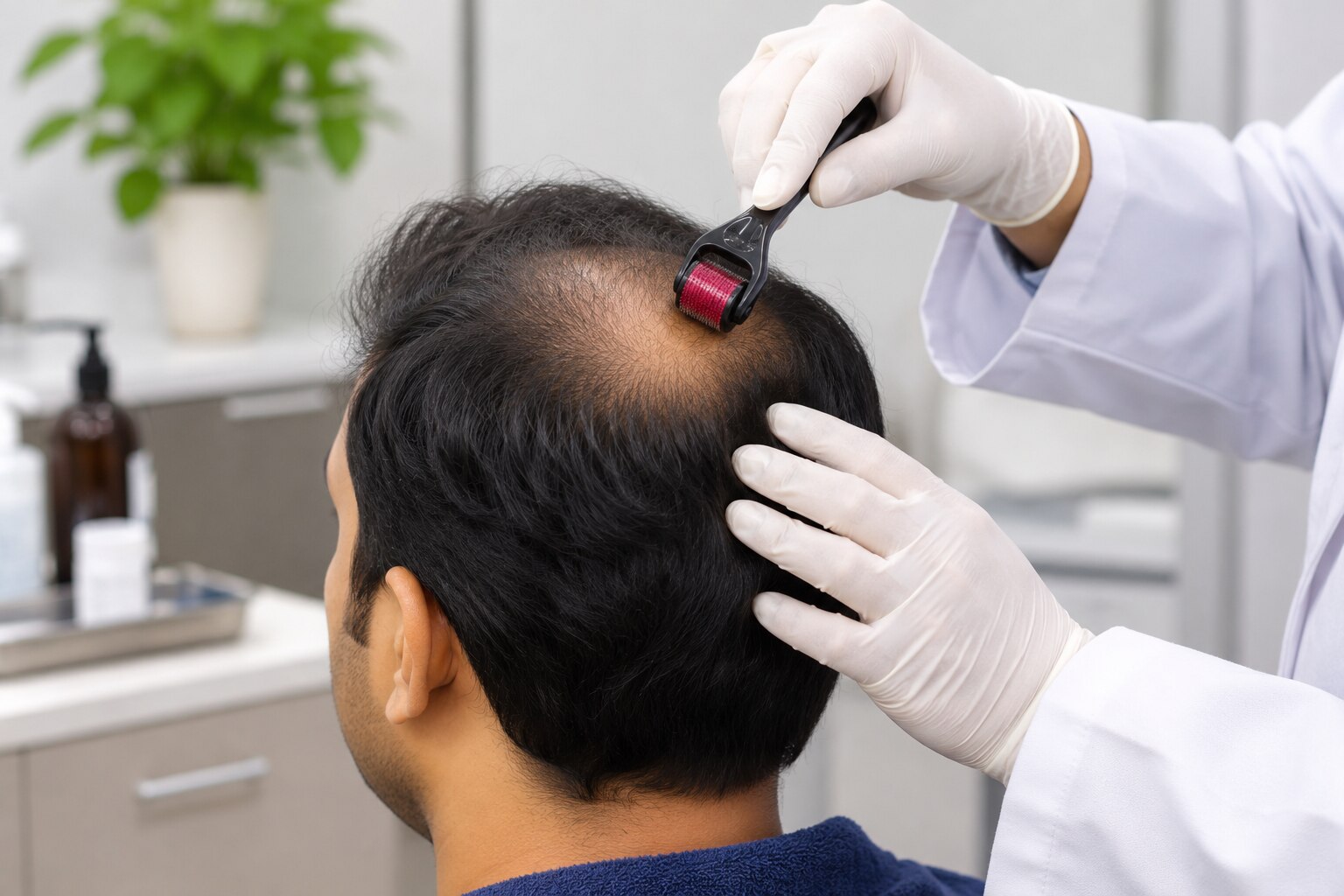
A widening crown can signal pattern hair loss, but it can also follow illness, nutritional deficiency, inflammation, or another condition that needs different treatment. By the end, you will know how to check for progression, which treatments target living miniaturised follicles, what results require, and when to seek a dermatologist rather than buy a package.
Key takeaways
- Compare same-angle photos to track crown thinning accurately.
- Treatment works best when started after identifying the cause.
- Minoxidil, finasteride, PRP, and hair transplantation suit different cases.
- Expect months of consistent treatment, not overnight regrowth.
How to tell whether the crown is actually thinning
A natural whorl exposes some scalp at the centre, making crown thinning easy to miss. Compare photographs taken from the same angle, under the same lighting, with hair equally dry and your head in the same position.
| Feature | Natural hair whorl | Possible progressive thinning |
|---|---|---|
| Scalp visibility | Limited to the whorl’s centre | Increasing visibility, especially under overhead light |
| Vertex shape | Stable over time | Widening area around the whorl |
| Hair density | Even around the whorl | Reduced density or finer hairs surrounding it |
A dermatologist checks the crown alongside the frontal hairline, sides, and donor area because pattern loss can begin at the vertex while the hairline still looks normal. Dermoscopy can reveal miniaturised hairs and changes that photographs miss.
Androgenetic alopecia is common, but telogen effluvium, alopecia areata, tinea, traction, scarring alopecia, thyroid or iron deficiency, and medication effects require different evaluation. The first assessment should cover onset, family pattern, shedding, recent illness, diet, and medicines. A search for hair regrowth dermatologist panvel describes a location, not a diagnosis.
Arrange prompt review for sudden patches, pain, itching, pustules, heavy scale, shiny skin, lost follicular openings, or rapid progression. These signs can indicate inflammation, infection, or scarring that threatens permanent follicle loss.
When can treatment help crown thinning?
Treatment is more likely to help when living, miniaturised follicles remain. A smooth, shiny, long-standing bald area has lost follicles and is less likely to regrow with medication.
A widening vertex with a relatively preserved hairline can signal early androgenetic alopecia. Sudden diffuse shedding after fever, major stress, weight loss, or a medication change points more toward telogen effluvium, where the goal is recovery after the trigger is addressed.
Pain, marked itching, pustules, heavy scale, shiny skin, or missing follicular openings needs prompt assessment because inflammatory or scarring disease can permanently destroy follicles.
| Goal | What treatment may achieve | Main limitation |
|---|---|---|
| Slow miniaturisation | Preserve existing crown hairs | It does not restore follicles that have been lost |
| Increase hair diameter | Make miniaturised hairs look fuller | Results depend on follicles still being active |
| Recover after shedding | Support return of hairs after telogen effluvium | Regrowth follows the hair cycle, not an instant product response |
| Add density | Move donor follicles into a bald crown | Transplantation does not stop loss in untreated native hairs |
A search for hair regrowth for crown thinning describes a symptom, not a diagnosis. Dermoscopy and a history of onset, family pattern, shedding, illness, diet, and medicines help separate pattern loss from alopecia areata, tinea, thyroid or iron deficiency, and medication effects. Choose treatment after identifying the cause, not from the crown pattern alone.
Which treatments are used for crown hair loss?
Topical minoxidil is the most accessible evidence-based option for crown thinning in men and women. A common regimen is 5% foam or solution once daily, but follow the product directions or prescription. Irritation, dandruff-like dermatitis, facial hair, dizziness, palpitations, or swelling require review; pregnancy, breastfeeding, low blood pressure, and heart disease require clinician-specific advice.
| Option | Purpose and suitability | Drawbacks and maintenance |
|---|---|---|
| Topical minoxidil | Supports existing follicles in pattern loss; suitable for men and women | A temporary shedding increase can occur; apply consistently and continue to maintain benefit |
| Finasteride 1 mg daily | For adult men with androgenetic alopecia; can slow vertex loss | Discuss sexual, breast, and mood-related effects; not routine self-treatment for women who could become pregnant; continue under prescription |
| PRP | Adjunct that may support density when follicles remain | Protocols and evidence vary; requires repeated clinic sessions |
| Low-level light devices | Modest improvement for some pattern-loss patients | Requires ongoing repeated use; not curative and should not delay diagnosis |
| Transplantation | Adds density using donor follicles in suitable candidates | Surgery, finite donor supply, and future native-hair loss remain; maintenance planning still matters |
Finasteride works only while continued, and stopping allows the underlying process to resume. The same principle applies to minoxidil. A transplant does not prevent untreated native hair from thinning.
Do not simply buy a hair regrowth treatment for crown thinning panvel if loss is rapid or patchy, or if pain, itching, pustules, heavy scale, shiny skin, or missing follicular openings appear. Those signs need prompt dermatology assessment for inflammation, infection, or scarring.
How long does crown regrowth take, and what does it require?
Expect at least three to six months before judging crown response, and allow six to twelve months for a fuller assessment. Hair cycles move slowly, so a daily mirror check cannot show whether treatment is working.
Photograph the crown at a fixed interval using the same camera position, lighting, hair length, and dryness. A different angle, wet hair, shorter hair, or overhead light can make the crown look better or worse without any real density change. Temporary shedding after starting treatment also does not prove failure; arrange clinical review before stopping.
| Treatment | What adherence requires | Maintenance |
|---|---|---|
| Topical minoxidil | Apply the prescribed or product-directed schedule, commonly once daily for 5% foam or solution | Continue to preserve benefit |
| Clinic procedures | Attend the planned series of appointments | Repeat sessions according to the protocol |
| Prescribed medicines, including finasteride | Take as directed and report adverse effects promptly | Continue while benefit is needed |
Minoxidil and finasteride do not permanently cure pattern hair loss. Stopping can allow the underlying process to resume, so your plan should state the review date, adverse-effect process, maintenance schedule, and next step if response is inadequate. Do not change treatment because of a short-term shed without speaking to the prescribing clinician.
How to choose a crown thinning treatment plan in Panvel
Do not choose a package until you can name the diagnosis and confirm whether miniaturised follicles remain. Ask how long the plan needs before review, what you must do daily or at appointments, its adverse effects, maintenance, total cost, and the next option if response is inadequate.
A search for crown hair thinning treatment panvel describes a location, not a diagnosis.
| Option | Best fit | Time and commitment | Main limitation |
|---|---|---|---|
| Topical minoxidil | Pattern thinning with living follicles | Daily use; assess at 3–6 months | Irritation, unwanted facial hair, early shedding; benefit requires continued use |
| Prescription oral medicine | Selected adults after medical review | Daily use; ongoing monitoring | Sexual, mood, breast, blood-pressure or other drug-specific effects |
| PRP or light-based treatment | An adjunct when repeated visits are acceptable | Multiple appointments or repeated device use | Variable evidence; maintenance is needed |
| Transplantation | Stable donor follicles and a suitable bald area | One or more procedures; long-term planning | Does not stop loss in untreated native hair |
Before surgery, ask for donor density, scalp laxity, miniaturisation, age, family-pattern progression, likely future loss, estimated graft requirement, and the proposed crown growth direction. A broad crown can require substantial graft planning, so a low package price does not prove adequate coverage.
A dermatologist-led service such as Dermaatriq in Panvel is relevant when examination, dermoscopy, treatment comparison and follow-up matter more than a fixed package. Ask what happens if the first plan fails.
Related services
Hair Regrowth Treatment At Dermaatriq Clinic, our Hair Regrowth Treatment is a scientifically designed, medically supervised solution aimed at addressing various types of... View service → |
Hair Fall Treatment At Dermaatriq Clinic, we understand that hair fall can affect both your confidence and overall well-being. Under the expert guidance of Dr. View service → |
Frequently asked questions
How can you tell whether the crown is actually thinning?
Compare photographs taken from the same angle, under the same lighting, with hair equally dry and your head in the same position. A dermatologist can also examine hair density and scalp condition.
When can treatment help crown thinning?
Treatment can help when follicles remain active, especially in pattern hair loss diagnosed early. The right option depends on the cause, the extent of loss, your medical history, and whether follicles have permanently stopped producing hair.
Which treatments are used for crown hair loss?
Common options include minoxidil, finasteride for appropriate patients, platelet-rich plasma, and hair transplantation. A dermatologist selects treatment after assessing the scalp and ruling out conditions such as alopecia areata or scalp inflammation.
How long does crown regrowth take?
Visible improvement usually requires several months of consistent treatment. You need ongoing maintenance for treatments that only work while continued, while transplantation requires healing and additional time for transplanted hairs to grow.
How do you choose a crown thinning treatment plan in Panvel?
Choose a qualified hair-loss dermatologist who identifies the cause, documents baseline photographs, explains expected results and side effects, and gives you a review schedule. Ask which treatments are suitable for your pattern of loss and what happens if the first plan does not work.
Related services
Hair Transplant Treatment Hair Transplant at Dermaatriq Clinic is a safe, advanced, and minimally invasive procedure designed to restore natural hair growth in areas affected... View service → |
Skin & Hair PRP Treatment PRP (Platelet-Rich Plasma) is a natural, non-surgical treatment that uses the patient’s own blood to rejuvenate skin and promote hair growth. View service → |
Keywords