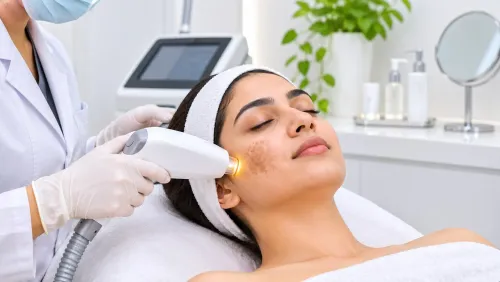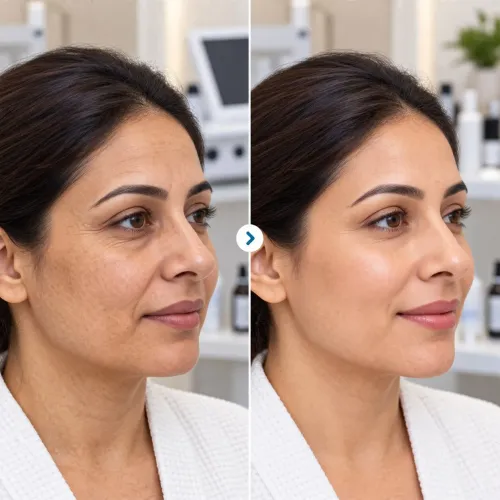
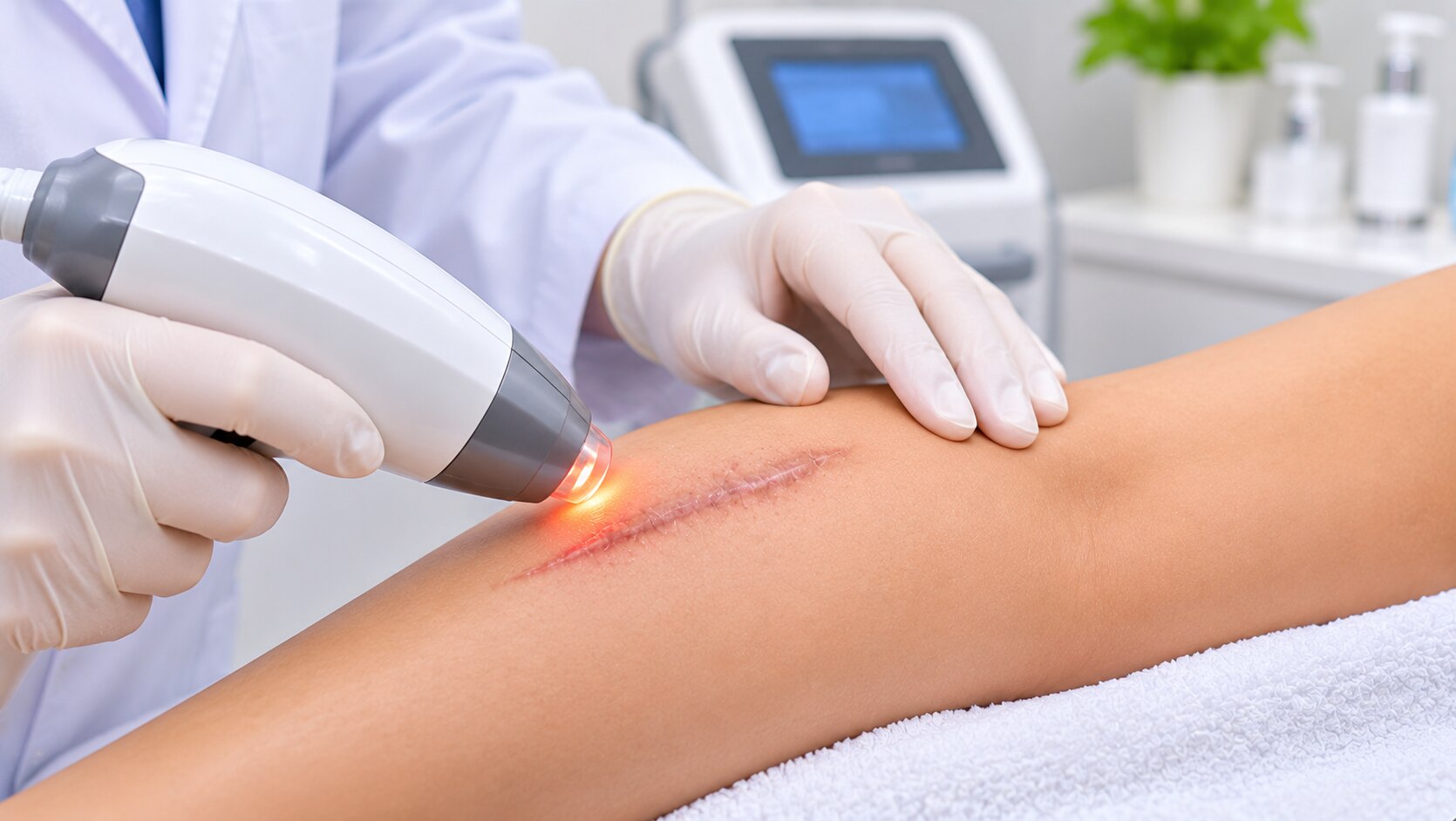
Fitzpatrick skin types IV, V, and VI can receive scar treatment, but procedures that create heat or controlled injury carry a greater risk of post-inflammatory hyperpigmentation and colour loss. You will learn how to identify the scar or mark you have, compare lower-trauma options, and prepare for a consultation that accounts for your pigmentation history and healing risk.
Key takeaways
- Fitzpatrick types IV to VI can receive scar treatment with individualized planning.
- Confirm whether the mark is a scar, post-inflammatory pigmentation, or both.
- Start with treatments that limit heat and inflammation when pigmentation risk is high.
- Ask about test spots, treatment settings, downtime, and post-treatment sun protection.
Can darker skin tones receive scar treatment safely?
Fitzpatrick skin types IV, V, and VI can receive scar treatment, but suitability is conditional—not determined by ethnicity alone. Your phototype, scar maturity, previous darkening or lightening after injury, and treatment goal matter.
A dermatologist should confirm whether the mark is a true scar or post-inflammatory hyperpigmentation (PIH), because pigment treatment will not raise a depressed scar or flatten a thick one.
For safer scar treatment for darker skin tones in Panvel, ask how the plan will control pigment risk:
- Use a test spot before treating a large area; it can reveal a strong response but cannot guarantee safety.
- Begin with staged sessions rather than one aggressive treatment.
- Match the laser wavelength and pulse settings to your phototype.
- Control heat with appropriate cooling, treatment depth, and intervals between sessions.
- Choose an operator experienced with pigmentation-prone skin.
The main risks are PIH, which causes persistent brown or grey darkening, and hypopigmentation, which creates lighter patches after inflammation or injury. A realistic goal is softer texture, reduced thickness, or improved colour—not guaranteed erasure. Delay treatment while the area is inflamed or the scar is still changing.
During a “scar treatment skin type Panvel” consultation, expect questions about prior keloids, dark marks, laser or peel reactions, medicines, and tanning. These details help determine whether treatment is appropriate and how cautiously to proceed.
Is the mark a scar or post-inflammatory pigmentation?
A flat brown or grey mark with normal skin texture is usually post-inflammatory hyperpigmentation (PIH), not a scar. PIH follows acne, injury, burns, or surgery when inflammation increases melanin production or transfers pigment into nearby skin; it can persist longer in Fitzpatrick types IV, V, and VI.
| Type | Appearance and feel | Clues to diagnosis |
|---|---|---|
| Atrophic acne scar | Depressed pit or rolling indentation; soft or tethered | The surface sinks, especially when side-lit |
| Hypertrophic scar | Raised, firm, pink, brown, or darker within the original wound | It stays inside the injury boundary |
| Keloid | Firm, shiny, raised growth that extends beyond the original wound | It may itch, hurt, or continue enlarging |
| Contracture scar | Tight, shortened band that restricts movement | Pulling the skin limits a joint or facial movement |
| Surgical scar | Linear mark that may be flat, depressed, or raised | Its shape follows an incision and its maturity changes over time |
| Burn scar | Irregular, shiny, tight, raised, depressed, lighter, or darker skin | Texture change and reduced flexibility follow the burn |
| PIH | Flat brown, grey, or black colour with normal texture | No depression, elevation, firmness, tightness, or movement restriction |
Colour alone cannot diagnose a scar. A mature scar usually becomes flatter, paler, and softer, while an active raised scar can remain firm, itchy, tender, or enlarging. Pigment treatment can fade PIH, but it cannot raise an atrophic scar, flatten a hypertrophic scar or keloid, or release a contracture.
A scar treatment for pigmentation prone skin panvel consultation should examine the mark by touch and movement before selecting treatment.
Which scar treatments are safer starting points for pigmentation-prone skin?
A dermatologist may start with the least inflammatory option that matches the scar type, maturity, Fitzpatrick phototype, and history of dark marks. For scar treatment for pigmentation prone skin panvel, the safer starting point is often conservative care rather than immediate resurfacing.
- Silicone gel or sheeting: Use only after the wound surface has fully closed, never over an open or infected area. Consistent use for weeks to months can soften or flatten a raised scar, but it will not erase it.
- Intralesional corticosteroid injections: These suit selected hypertrophic scars and keloids. Keloids extend beyond the original wound, and injections may be combined with pressure therapy, silicone, cryotherapy, or surgery.
- Pressure therapy: A fitted pressure dressing can reduce thickness in selected raised scars. Excessive pressure causes ulceration, pain, or skin damage.
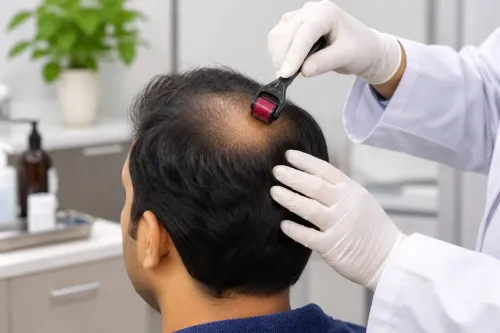
- Microneedling: Conservative treatment can suit selected atrophic acne scars because it creates mechanical dermal injury without broadly removing the epidermis. Delay it during active acne, infection, or inflammation; repeated passes and aggressive combinations raise PIH risk.
| Option | Safer role | Main concern |
|---|---|---|
| Fractional non-ablative | Staged treatment for texture with test areas first | Heat can still trigger PIH or hypopigmentation |
| Aggressive ablative resurfacing | Reserved for carefully selected cases | Greater injury, downtime, and pigment risk |
| Surgery for keloid | Consider only with recurrence-reduction planning | Simple excision alone often fails |
Expect softer texture or reduced thickness, not complete erasure. A scar treatment skin type panvel consultation should document test results and follow-up before treatment.
When can peels, IPL, or aggressive laser treatment worsen pigmentation?
Heat or chemical injury becomes a poor choice when your skin is already inflamed, recently tanned, or prone to prolonged dark marks. Fitzpatrick types IV, V, and VI contain more melanin, so injury can trigger post-inflammatory hyperpigmentation, uneven hypopigmentation, burns, blistering, or months of redness.
IPL is not automatically safe for darker skin. Its broad-spectrum light can be absorbed by melanin in the surrounding skin, not only by the target; excessive fluence or inadequate cooling can cause blistering and pigment change.
Chemical peels can do the same when the acid is too strong, left on too long, or applied over active inflammation. Carbon-based laser treatments also create heat and are not risk-free because the carbon does not prevent surrounding melanin from absorbing energy.
Higher-risk procedures include:
- Ablative resurfacing, which removes or vaporises epidermis and can prolong inflammation.
- Fractional ablative lasers, which leave columns of thermal injury; “fractional” does not mean risk-free.
- Deep or repeated laser passes, especially without adequate intervals, cooling, and wound care.
- Aggressive peel-and-laser combinations that multiply injury before the skin recovers.
Conservative energy, shallow treatment depth, cooling, sun protection, and prescribed aftercare reduce risk but cannot guarantee normal pigmentation. Delay elective scar treatment for darker skin tones Panvel or scar treatment for pigmentation prone skin Panvel when active acne, dermatitis, infection, an unhealed wound, or another inflammatory source is present. Treat that problem first.
What should you ask at a dermatologist scar-treatment consultation in Panvel?
A suitable plan starts with diagnosis, phototype, scar maturity and your pigment history—not a promise that the scar will disappear. In a dermatologist scar treatment Panvel consultation, ask how the proposed procedure fits your skin type and whether active acne, dermatitis, infection or an unhealed wound requires postponement.
1. Ask whether the clinician has recorded your Fitzpatrick phototype and identified the mark as a scar, post-inflammatory pigmentation, or both.
2. Provide your history of keloids, hypertrophic scars and family keloids. Mention isotretinoin and every other medicine or supplement, previous herpes infections, recent tanning, pregnancy-related pigmentation, and reactions to peels or lasers.
3. Ask for the exact treatment settings: laser wavelength, energy, pulse duration, cooling, needle depth, chemical strength and treatment interval. Request a test spot and ask what result would stop or modify the full treatment.
4. Confirm wound-care instructions, including when to cleanse, apply the prescribed ointment, avoid picking, and resume products. Ask how long redness or crusting should last.
5. Ask which broad-spectrum sunscreen to use, how often to reapply outdoors, and whether protective clothing is needed. A tinted product containing iron oxides adds visible-light protection for pigmentation-prone skin.
6. Get clear reporting instructions: contact the clinic promptly if the area becomes unexpectedly darker, lighter, blistered, increasingly painful or infected.
A consultation with Dermaatriq can be useful when you want the diagnosis, settings, test-spot strategy, follow-up and realistic endpoint documented. Experience managing pigmentation-prone skin matters more than a scar-removal guarantee.
Related services
Scars Treatment Scars can affect not just your skin’s appearance but also your confidence. View service → |
Anti-Pigmentation Treatment At Dermaatriq Clinic, our Advanced Anti-Pigmentation Treatment is designed to effectively target and reduce dark spots, uneven skin tone, melasma,... View service → |
Frequently asked questions
Can darker skin tones receive scar treatment safely?
Yes. Fitzpatrick skin types IV, V, and VI can receive scar treatment when a dermatologist considers your phototype, scar maturity, past pigment changes, and treatment goal.
How can you tell whether a mark is a scar or post-inflammatory pigmentation?
A scar changes the skin’s texture, such as a depression, raised area, firmness, or tethering. Post-inflammatory pigmentation changes colour without altering texture. Both can occur together.
Which scar treatments are safer starting points for pigmentation-prone skin?
A dermatologist may begin with conservative options suited to the scar type, including silicone therapy for raised or fresh scars, careful topical treatment for pigment, or low-intensity procedures with a test spot.
When can peels, IPL, or aggressive laser treatment worsen pigmentation?
Risk rises when treatment causes excessive heat or inflammation, the settings are too strong, the skin is recently tanned or irritated, aftercare is poor, or the procedure does not match the scar type.
What should you ask at a dermatologist scar-treatment consultation in Panvel?
Ask whether the mark is a scar or pigmentation, which Fitzpatrick type you have, why the proposed treatment fits, whether a test spot is needed, expected downtime, sun protection instructions, and the risk of darker or lighter skin.
Related services
Medical Micropigmentation Medical Micropigmentation is a specialized, non-surgical cosmetic procedure designed to restore, enhance, or correct the appearance of skin by... View service → |
IPL Photo Facial Treatment IPL (Intense Pulsed Light) Photo Facial is a non-invasive skin rejuvenation treatment designed to improve overall skin tone, clarity, and texture. View service → |
Microneedling Treatment Microneedling is an advanced skin rejuvenation procedure offered at Dermaatriq Clinic under the expert care of Dr. Swapnalie D. Mange. View service → |
Carbon Magic Peel Treatment Carbon Magic Peel is an advanced, non-invasive laser skin rejuvenation treatment designed to deeply cleanse, exfoliate, and revitalize the skin for a... View service → |
Keywords